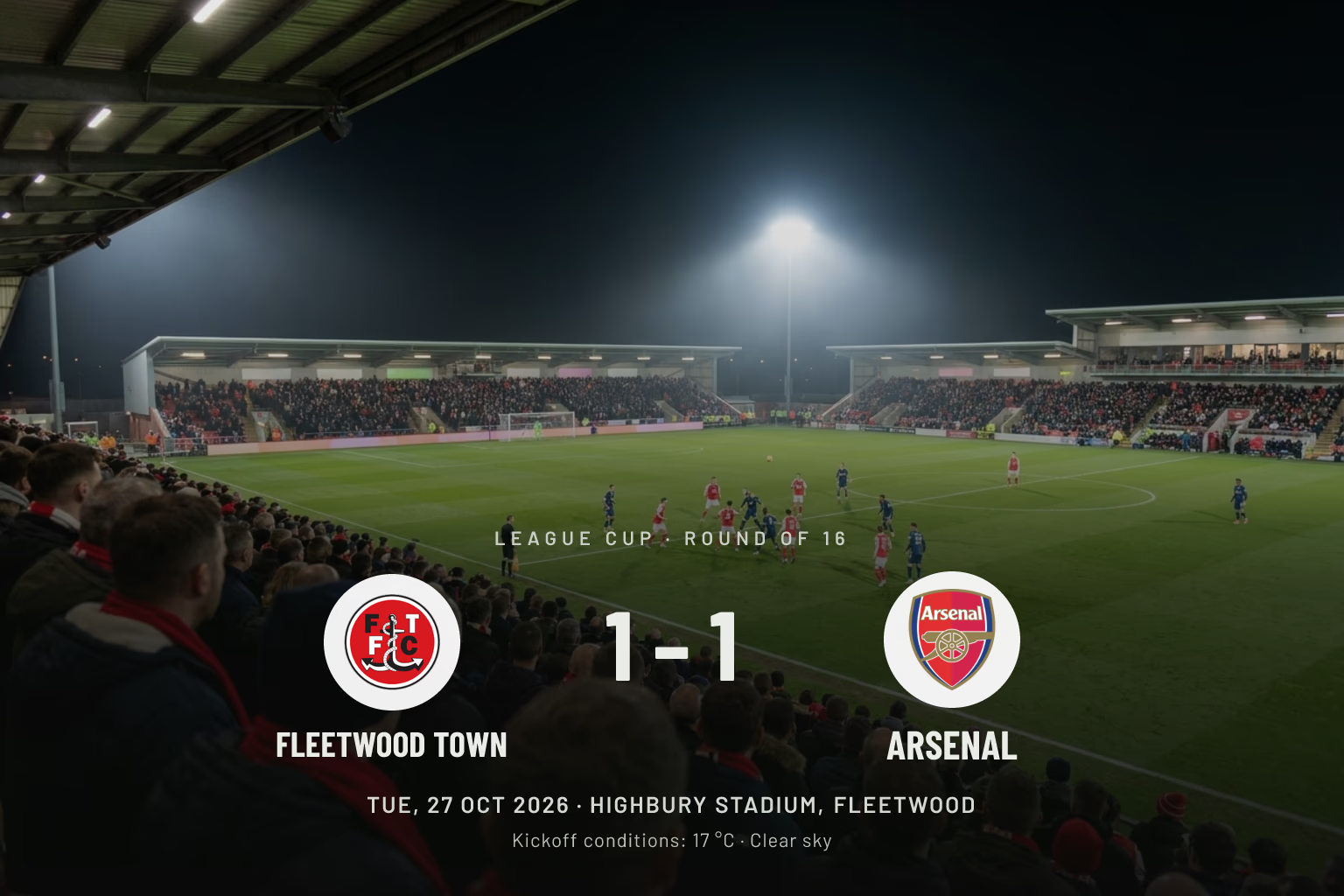

Fleetwood Town 1-1 Arsenal (Fleetwood win 5-3 on penalties)
Fleetwood Town are through. Arsenal are out. The tie was settled at Highbury Stadium on Tuesday, 27 October 2026, not through chance volume or territorial dominance, but through nerve.
P. Wild’s side held Mikel Arteta’s Arsenal to a 1-1 draw in the League Cup Round of 16, then won 5-3 on penalties. The numbers say Arsenal should have finished the tie long before the shootout. The match said something else: Fleetwood stayed alive, Jay Lynch kept them there, and Bruno Guimarães’ missed penalty, recorded in the 96th minute of the event log, opened the door for Conor Haughey to settle it in the 97th.
Fleetwood led in the 21st minute, when Aaron Loupalo-Bi scored from Harrison Neal’s assist. Arsenal levelled in the 50th minute through Viktor Gyökeres. That was the match in normal play: one clean Fleetwood moment, one Arsenal response, then a long argument between pressure and resistance.
Match report
This was not a rivalry with old scars. It was the old cup equation: Premier League weight against lower-league clarity, Arsenal’s volume against Fleetwood’s patience.
Fleetwood started in a 3-1-4-2 under P. Wild, with J. Lynch in goal, Conor Haughey, R. Bennett and F. Potter as the back three, Harrison Neal screening, S. Rooney, C. McLean, M. Helm and Jake Thomas Batty across midfield, and C. Evans with A. Loupalo-Bi up front.
Arsenal lined up in Mikel Arteta’s 4-2-3-1: I. Meslier in goal, J. Timber, Cristhian Mosquera, M. Salmon and P. Hincapié in defence, Martín Zubimendi and M. Lewis-Skelly as the double pivot, Max Dowman, K. Havertz and Ceadach O’Neill behind Viktor Gyökeres.
Fleetwood’s plan was simple, not simplistic. They protected the middle, allowed Arsenal to build large passages without turning that control into clean finishing, and trusted Loupalo-Bi to make the first contact count. He did exactly that in the 21st minute, scoring after Harrison Neal’s assist. One shot on target, one goal, and suddenly Arsenal had a problem that possession alone could not solve.
Arteta reacted at the break. Martin Ødegaard came on for Marli Salmon in the 45th minute, and Ben White replaced Jurriën Timber in the 45th minute. It changed Arsenal’s rhythm. Ødegaard immediately gave them cleaner angles, better tempo and more purpose between the lines. Five minutes later, Gyökeres scored in the 50th minute.
The pattern was clear: Arsenal had the shots, the expected goals and far more passes. Possession itself was only 52% to 48% in Arsenal’s favour, but the away side still created the volume. Fleetwood had the game where they needed it to be: narrow, uncomfortable and alive.
Crispin McLean was booked in the 54th minute, then replaced by Adam Murphy in the 66th minute. Ronan Coughlan also came on for Ched Evans in the 66th minute. Arsenal sent on Eberechi Eze for Ceadach O’Neill in the 66th minute, another sign that Arteta wanted invention, not just circulation.
Jake Thomas Batty was booked in the 74th minute, the same minute Andy Cannon replaced Mark Helm. Batty’s work mattered more than the card: six tackles, six interceptions and seven duels won. He gave Fleetwood a platform when Arsenal were trying to pin them in.
Then came the swing. Bruno Guimarães replaced Martín Zubimendi in the 82nd minute, Ezri Konsa came on for Myles Lewis-Skelly in the 82nd minute, and Fleetwood sent on Will Davies for Aaron Loupalo-Bi in the 82nd minute. Three minutes later, Max Dowman was sent off in the 85th minute for violent conduct. Andy Cannon was booked in the 86th minute for argument.
For Arsenal, it was the worst possible late twist. They had been dominant in attempts and territory but not ruthless. Now they had to finish the job with ten men.
They did not.
Penalty shootout
The shootout was ruthless from Fleetwood.
The penalty events were logged from the 91st to the 97th minute. Ronan Coughlan scored first for Fleetwood in the 91st minute, and Martin Ødegaard answered for Arsenal in the 92nd.
Harrison Neal scored in the 93rd minute, and Kai Havertz replied in the same minute.
Will Davies scored in the 94th minute. Viktor Gyökeres scored for Arsenal in the 95th minute. Andy Cannon then scored in the 95th minute.
Then came the decisive event: Bruno Guimarães missed in the 96th minute.
Conor Haughey scored in the 97th minute. Fleetwood won 5-3 on penalties. Arsenal were eliminated, and Fleetwood moved into the next round.
Why Fleetwood survived
Fleetwood’s win was not built on attacking volume. They had three total shots and 0.34 expected goals. It was built on timing, discipline and the goalkeeper.
Loupalo-Bi was the outlet. His goal in the 21st minute gave Fleetwood something to protect, but his wider contribution mattered too: five successful dribbles from six attempts, six duels won and enough threat to stop Arsenal fully squeezing the pitch.
Harrison Neal was just as important. He assisted the opener, scored in the shootout in the 93rd minute, and sat in the role that connected Fleetwood’s defensive shape to their transitions. His 20 passes were not glamorous, but they were part of the control Fleetwood found without dominating the ball.
Jay Lynch made five saves. That line explains the match better than any speech. Arsenal put seven shots on target. Fleetwood’s goalkeeper kept the tie alive long enough for penalties to become the equaliser.
Conor Haughey also deserves headline space. He started in the back three, helped absorb a night of pressure, then scored the final penalty in the 97th minute. That was a big moment handled with a clear head.
Arsenal’s failure was familiar
Arsenal produced 26 shots, 23 from inside the box, 2.28 expected goals and 641 passes. They had enough territory and chance volume to win two cup ties. They did not have enough precision to win this one.
Gyökeres did his part. He scored in the 50th minute, then converted his penalty in the 95th minute. He finished with three shots, two on target, and gave Arsenal the one moment of attacking certainty they badly needed.
Ødegaard changed the tone after coming on in the 45th minute. He completed 53 of 61 passes, made three key passes, had one shot on target and scored in the shootout in the 92nd minute. Eze, introduced in the 66th minute, also added three key passes. Arteta’s bench improved Arsenal. It still did not finish Fleetwood.
The issue was conversion. Havertz had seven shots but only one on target, although he scored his penalty in the 93rd minute. Lewis-Skelly had four shots without hitting the target. Dowman had three shots, including two on target, but his red card in the 85th minute changed the emotional temperature of the tie and narrowed Arsenal’s margin for error.
Then Bruno Guimarães missed in the 96th minute. In a shootout, that is the clause that matters.
Key numbers
| Statistic | Fleetwood Town | Arsenal |
|---|---|---|
| Expected goals | 0.34 | 2.28 |
| Possession | 48% | 52% |
| Total shots | 3 | 26 |
| Shots on goal | 2 | 7 |
| Shots inside box | 3 | 23 |
| Accurate passes | 99 | 566 |
| Total passes | 180 | 641 |
| Corner kicks | 2 | 5 |
| Goalkeeper saves | 5 | 1 |
| Fouls | 14 | 5 |
| Yellow cards | 3 | 0 |
| Red cards | 0 | 1 |
What it means
For Fleetwood, this is a cup result with real weight. Not just because Arsenal were beaten, but because they were beaten in a match Arsenal largely controlled through shots, passing volume and expected goals. P. Wild’s side had to suffer, then execute. They did both.
For Arsenal, the exit lands badly. Arteta rotated, then escalated with Ødegaard, White, Eze, Bruno Guimarães and Konsa. The response came, but the finish did not. In knockout football, control without punishment becomes risk. Against Fleetwood, Arsenal paid the full price.
Fleetwood move on to the next round with momentum and a night their supporters will not hand back. Arsenal return to bigger targets, but with one competition gone and a clear warning attached: domination is not a trophy.