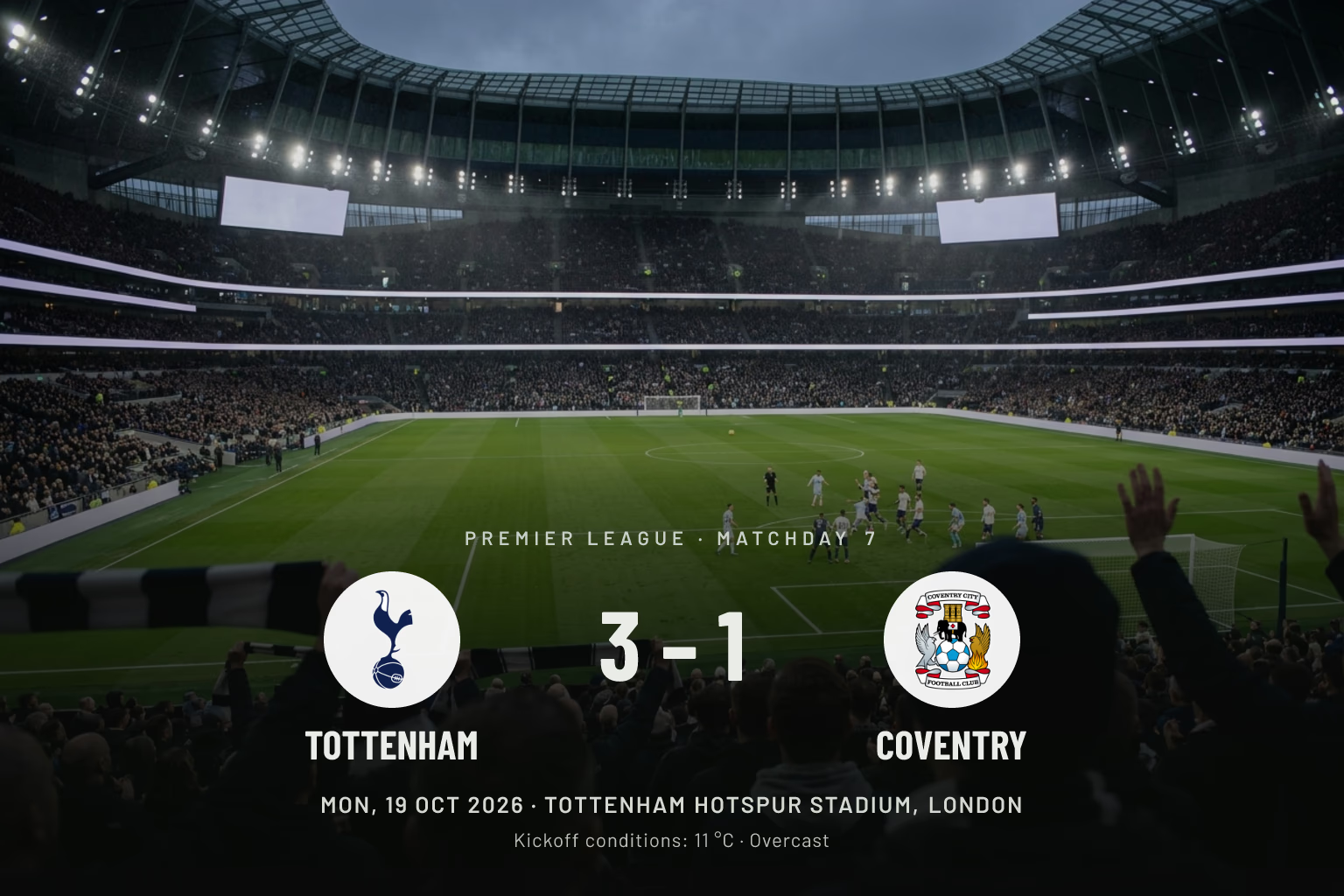



Tottenham 3-1 Coventry: Maddison Opens the Door, Davies Locks It Late
Tottenham finally have their first Premier League win of the season. On October 19, 2026, at the Tottenham Hotspur Stadium, T. Frank’s side beat Coventry 3-1, a result that mattered less for style than for oxygen.
This was a bottom-end pressure game, not a glamour fixture. Tottenham began the night needing proof that their possession could become points. Coventry arrived under F. Lampard trying to protect their narrow cushion above the relegation places, brave enough to make the match uncomfortable, but not clean enough to take anything from it.
James Maddison gave Spurs the lead in the 14th minute, assisted by Mohammed Kudus. Jack Rudoni pulled Coventry level in the 49th minute from Brandon Thomas-Asante’s assist. Tottenham answered quickly: Omar Marmoush scored in the 58th minute, assisted by Andrew Robertson. Ben Davies, on as a substitute, finished it in the 90+6th minute after Dominic Solanke supplied the assist.
Deal done for Tottenham. Not polished, not dominant in chance quality, but vital.
How Tottenham Set Up
Tottenham started in a 4-2-3-1 under T. Frank.
Antonín Kinský was in goal. The back four was Jan Paul van Hecke, Tosin Adarabioyo, Micky van de Ven and Andrew Robertson. Archie Gray and Sandro Tonali formed the double pivot. Mohammed Kudus, James Maddison and Omar Marmoush played behind Dominic Solanke.
Coventry also lined up in a 4-2-3-1 under F. Lampard.
Cian Rushworth started in goal, with Mads van Ewijk, Ben Thomas, Ethan Pinnock and Jay Dasilva across the defence. Caleb Marfo Yirenkyi and Matt Grimes sat in midfield. Tatsuhiro Sakamoto, Jack Rudoni and Brandon Thomas-Asante supported Sidiki Cherif.
The symmetry mattered. Both teams had the same basic structure, but Tottenham had the cleaner passers and the better connectors between midfield and attack. Coventry had moments, especially through Thomas-Asante and Rudoni, but Spurs had the players who changed the score.
The Match
Maddison’s goal in the 14th minute settled Tottenham. Kudus provided the assist, and that combination was the clearest early sign of Spurs finding rhythm between the lines. Maddison did not just score. He gave Tottenham a reference point, drawing fouls, taking touches in crowded areas and helping turn possession into territory.
The match then became choppy. Caleb Yirenkyi was booked in the 20th minute for Coventry. Solanke followed with a yellow card in the 22nd minute for Tottenham. Jay Dasilva was booked in the 45th minute, another sign of Coventry being forced to defend in awkward spaces.
Yet Coventry did not fold. Rudoni scored in the 49th minute, assisted by Thomas-Asante, and suddenly Spurs had to answer the question that has haunted poor starts to seasons: what happens when comfort disappears?
The answer came in the 58th minute. Marmoush scored, assisted by Robertson, restoring Tottenham’s lead before anxiety could fully take hold. That was the decisive passage. Coventry had worked their way back into the game, but Tottenham’s response was immediate enough to stop the match turning emotional.
Lampard moved first from the bench in the 60th minute, sending Taiwo Awoniyi on for Sidiki Cherif and Frank Onyeka on for Caleb Yirenkyi. Rudoni was then booked in the 64th minute, reducing Coventry’s room for aggression in midfield.
Frank made his first changes in the 69th minute: Ben Davies replaced Robertson, and Conor Gallagher replaced Maddison. Two minutes later, Mateus Fernandes came on for Adarabioyo. Coventry responded in the 78th minute with Ephron Mason-Clark for Thomas-Asante and Gustavo Hamer for Tatsuhiro Sakamoto.
In the 87th minute, Tottenham introduced Mathys Tel for Marmoush, while Kudus also came off in the same change window. Coventry made their final change at the same time, with Kaine Kesler-Hayden replacing Rudoni.
Then came the final confirmation. Davies, who had come on in the 69th minute, scored in the 90+6th minute from Solanke’s assist. It gave Tottenham the cushion the match had never fully promised.
The Numbers
| Statistic | Tottenham | Coventry |
|---|---|---|
| Possession | 66% | 34% |
| Total shots | 16 | 12 |
| Shots on goal | 5 | 1 |
| Shots inside box | 10 | 11 |
| Expected goals | 0.9 | 0.79 |
| Total passes | 566 | 290 |
| Accurate passes | 505 | 225 |
| Corners | 4 | 4 |
| Fouls | 15 | 14 |
| Yellow cards | 1 | 3 |
The scoreline says control. The data says something tighter.
Tottenham had 66% possession and completed 505 passes, but their expected goals total was only 0.9. Coventry, with 34% possession, produced 12 shots and 11 from inside the box, yet only one shot on goal. That was the match in miniature: Spurs had the ball and the finishers, Coventry had enough access to worry them but not enough precision.
Van Hecke’s 97 passes and Van de Ven’s 83 told the story of Tottenham’s base control. Tonali added 68 passes and two key passes. Spurs built patiently, sometimes too patiently, but they rarely lost the thread.
Why Maddison, Kudus and Marmoush Mattered
Maddison was the best player on the pitch. He scored in the 14th minute, completed 48 of 55 passes, won all four of his duels and drew four fouls. That is not decoration. That is control under contact. Tottenham needed a player to slow the match down when required and speed it up when gaps appeared. Maddison did both before making way in the 69th minute.
Kudus was the most dangerous connector. His assist for Maddison set the match in motion, and his passing was sharp: 29 accurate passes from 30, plus two key passes. Coventry struggled to pin him down when he received between full-back and centre-back zones.
Marmoush was decisive because he turned involvement into output. He had two shots on target and scored in the 58th minute, the goal that restored Tottenham’s lead after Rudoni’s equaliser. In a match of limited high-value chances, that efficiency was everything.
Robertson also left a mark. His assist for Marmoush in the 58th minute was his key contribution before Davies replaced him in the 69th minute. Davies then changed his own evening with the goal in the 90+6th minute. That is how benches win matches: not always by changing the pattern, sometimes simply by adding a final action.
Solanke’s night was mixed but important. Booked in the 22nd minute, caught offside twice, and without a shot on target from three attempts, he still supplied the assist for Davies in the 90+6th minute. For a striker, there are games where the clean finish does not arrive. The useful action still can.
Coventry’s Plan Had Logic, Not Enough Edge
Coventry were not passive. Thomas-Asante assisted Rudoni’s goal in the 49th minute and had a combative game: 18 duels, nine won, four fouls drawn. Rudoni gave Lampard the equaliser and carried threat with two shots, one on target, before his yellow card in the 64th minute and substitution in the 87th minute.
Mads van Ewijk was Coventry’s best outlet from deep, producing three key passes and winning six of seven duels. Matt Grimes kept them moving with 42 accurate passes from 49. But Coventry’s issue was final clarity. Twelve shots brought only one on goal. That is not enough away from home, especially when chasing after the 58th minute.
Lampard’s 60th minute double change made sense. Awoniyi gave Coventry a more direct forward option, while Onyeka added energy and ball-winning in midfield. Hamer and Mason-Clark arrived in the 78th minute to refresh the attacking line. But Tottenham had already taken back the lead, and Coventry never found a second clean action to match the first.
What It Means
Tottenham remain 16th with 6 points from 7 matches, but this was the first win they badly needed. The gap to danger is still thin. The performance was not a reset of everything, but it was a green light for Frank’s attacking structure: Maddison central, Kudus roaming, Marmoush threatening, Solanke still involved even without scoring.
Coventry stay 17th with 6 points from 7 matches, just above the relegation places. Their form now reads LWWLL, and the concern is obvious: they compete, they create enough moments to stay in games, but they are conceding too often and finishing too little.
For Tottenham, the next step is turning this into a run. One win does not change a season. It changes the timeline. Now Frank has something to build from.