


Egypt 0-1 South Africa: Dithejane punishes Egypt as Ntseki gets a clean-sheet friendly win
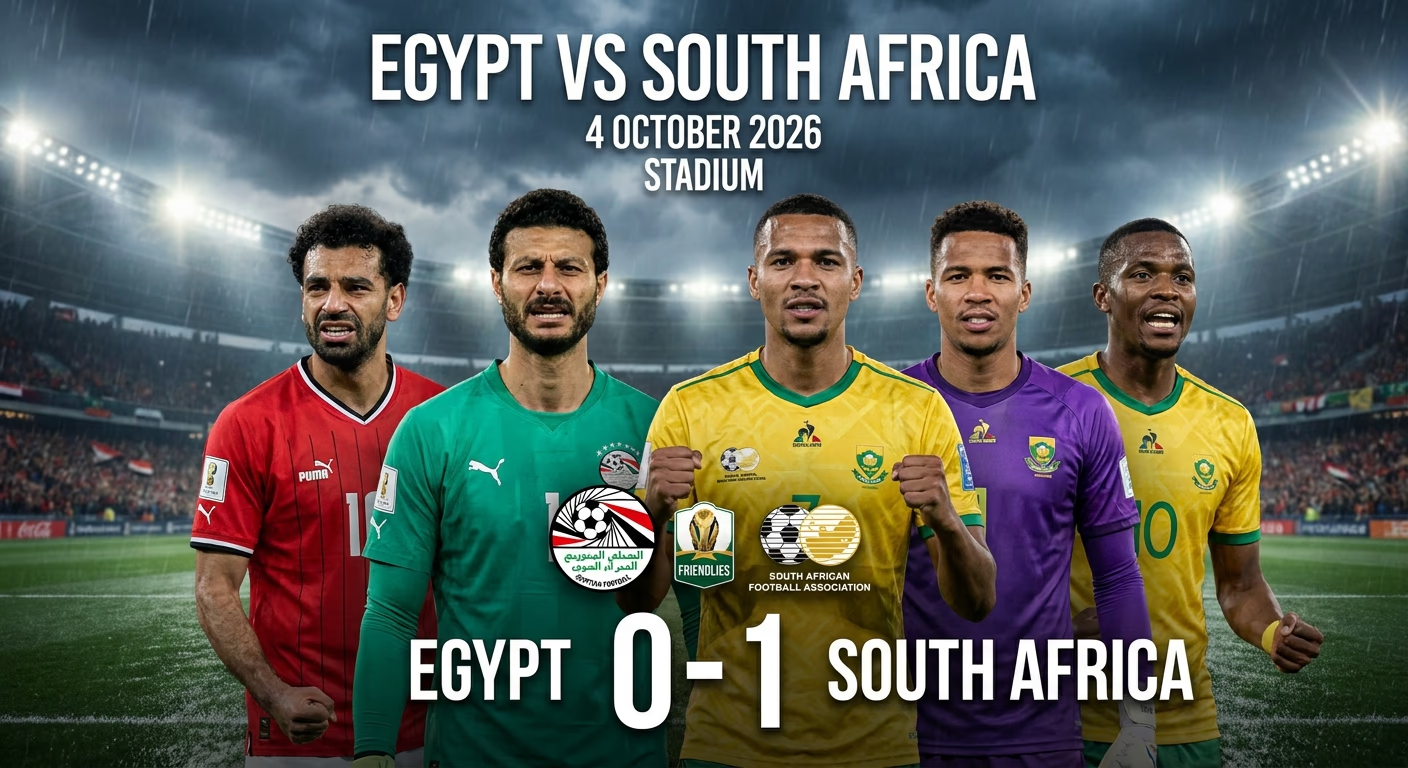
South Africa left Egypt with the result that mattered in this Friendly International on 4 October 2026. Egypt had the ball, the territory, the shot count and the late push. South Africa had Puso Dithejane, a compact defensive block, and six saves from Sipho Chaine and Ricardo Goss. Final score: Egypt 0-1 South Africa.
The only goal came in the 51st minute, when Puso Dithejane scored for South Africa. The official event data listed it as a normal goal with no assist recorded, while match reports described Dithejane as taking advantage of a Mostafa Shobeir error.
For Hossam Hassan, this was a flat end to Egypt’s international break after a 0-0 draw with Angola and a 5-0 win over South Sudan in Africa Cup of Nations qualifying. For M. Ntseki, it was exactly the kind of friendly win coaches value: away from home, under pressure for long spells, with a clean sheet protected by structure and game management.
The shape of the game
The official lineup data listed no formal formation for Egypt and no formal formation for South Africa.
Egypt still looked like a side built around a back four and a packed midfield line: Mostafa Shobeir in goal, Mohamed Hany, Hossam Abdelmaguid, captain Rami Rabia and Karim Hafez behind Ibrahim Adel, Mohanad Lasheen, Marwan Attia and Emam Ashour, with Mostafa Ziko and Omar Marmoush ahead of them.
South Africa started with Sipho Chaine in goal, Tholo Thabang Matuludi, Lebone Seema, Ime Okon and Fawaaz Basadien in defence, Yaya Sithole, Brooklyn Poggenpoel, Puso Dithejane, Tashreeq Matthews and Luther Singh across midfield, and Cassius Mailula as the forward.
Egypt had 61% possession and completed the match with 560 passes. They took 19 shots and won eight corners. On the surface, the plan was clear: dominate the ball, work the wide areas, load the box and force South Africa to defend repeatedly.
South Africa accepted those terms, then changed the match.
Ntseki made three changes at the break: Tshepang Moremi replaced Tashreeq Matthews in the 46th minute, Khulumani Ndamane replaced Ime Okon in the 46th minute, and Shandre Campbell replaced Luther Singh in the 46th minute. Egypt also moved early, with Osama Faisal replacing Emam Ashour in the 46th minute.
Five minutes later, South Africa had the lead. Dithejane scored in the 51st minute, and the rhythm of the game changed.
Why South Africa won
South Africa won because they defended the box better than Egypt attacked it.
Egypt had 12 shots from inside the box, but South Africa’s defensive concentration held. Lebone Seema was central to that. His numbers told the story: three blocks, one tackle, one interception and a calmness that mattered as Egypt’s pressure grew. He was not just clearing danger; he was slowing Egypt’s attacks before they became clean chances.
Behind him, the goalkeeping plan worked. Sipho Chaine made two saves before being replaced by Ricardo Goss in the 62nd minute. Goss then made four saves. That was the decisive detail in a one-goal game: Egypt found the target six times, and South Africa’s goalkeepers dealt with all six efforts.
Dithejane was the match-winner, but not only because of the goal. He had three shots, one on target, one key pass, three tackles and won four of his eight duels. He gave South Africa a pressure valve, a runner, and then the decisive moment. He came off in the 77th minute, replaced by Thapelo Morena, with his work done.
Egypt’s best individual performance came from Mohanad Lasheen, who was excellent without receiving the reward. He won all 11 of his duels, made seven tackles, added two interceptions and kept Egypt competitive in midfield. On another night, that becomes the platform for a comeback. Here, it became a strong individual statistic in a defeat.
Egypt’s problem: volume without clarity
Hassan’s side produced enough pressure to avoid a blank. The issue was the quality of the final action.
Karim Hafez created three chances from the left side. Zizo, introduced for Marwan Attia in the 69th minute, added two key passes in 21 minutes. Osama Faisal, on from the 46th minute, put both of his shots on target. Hamza Abdelkarim, who replaced Omar Marmoush in the 69th minute, took three shots and won all three of his duels.
The bench gave Egypt energy. It did not give them a goal.
Marmoush worked, carried and won six of his 11 duels, but South Africa crowded the central lanes and forced Egypt into effort after effort without allowing the game to become stretched enough for him to take over. Mostafa Ziko had one shot on target and was booked at 90+6. Mohamed Hany had a strong all-round game, with 57 passes, one key pass and three interceptions, but he was booked for argument in the 88th minute before being replaced by Tarek Alaa in the 90th minute.
Egypt finished with the numbers of a side that should have scored. South Africa finished with the result of a side that understood exactly what it had to protect.
Match statistics
| Statistic | Egypt | South Africa |
|---|---|---|
| Possession | 61% | 39% |
| Total shots | 19 | 7 |
| Shots on goal | 6 | 3 |
| Shots off goal | 9 | 3 |
| Blocked shots | 4 | 1 |
| Shots inside box | 12 | 2 |
| Shots outside box | 7 | 5 |
| Corner kicks | 8 | 1 |
| Fouls | 8 | 10 |
| Offsides | 3 | 1 |
| Goalkeeper saves | 2 | 6 |
| Total passes | 560 | 366 |
| Accurate passes | 474 | 285 |
| Pass accuracy | 85% | 78% |
| Yellow cards | 2 | 4 |
Cards and control
South Africa walked a disciplinary line but stayed on the right side of it.
Brooklyn Poggenpoel was booked for a foul in the 31st minute. Khulumani Ndamane, who came on at the break, was booked in the 55th minute. Yaya Sithole saw yellow for argument in the 77th minute, before Olwethu Makhanya was booked at 90+6.
Egypt’s frustrations showed late. Mohamed Hany was booked in the 88th minute, and Mostafa Ziko was booked at 90+6.
No red cards. Plenty of edge. South Africa used that edge better.
Substitutions
Egypt:
- 46th minute: Osama Faisal on for Emam Ashour
- 69th minute: Hamza Abdelkarim on for Omar Marmoush
- 69th minute: Zizo on for Marwan Attia
- 77th minute: Mahdi Soliman on for Mostafa Shobeir
- 90th minute: Tarek Alaa on for Mohamed Hany
South Africa:
- 46th minute: Tshepang Moremi on for Tashreeq Matthews
- 46th minute: Khulumani Ndamane on for Ime Okon
- 46th minute: Shandre Campbell on for Luther Singh
- 62nd minute: Ricardo Goss on for Sipho Chaine
- 63rd minute: Yanela Mbuthuma on for Cassius Mailula
- 77th minute: Thapelo Morena on for Puso Dithejane
- 77th minute: Olwethu Makhanya on for Brooklyn Poggenpoel
- 90th minute: Nkosinathi Sibisi on for Yaya Sithole
What it means
For Egypt, this was a warning. Hassan has enough possession, enough technical quality and enough depth from the bench. The missing clause is ruthlessness. Nineteen shots and no goal at home is not a small detail.
For South Africa, this is the kind of away friendly that travels well. Ntseki got minutes into the squad, used eight substitutions, protected the lead after the 51st minute, and left with a clean sheet. Deal done.
The international calendar keeps moving, including South Korea vs Uzbekistan, but both Egypt and South Africa will take different lessons from this one. Egypt need sharper finishing. South Africa have proof that their defensive plan can hold under pressure.