
Uzbekistan 4-1 Syria: Norchaev drives Cannavaro’s side through a controlled Tashkent test
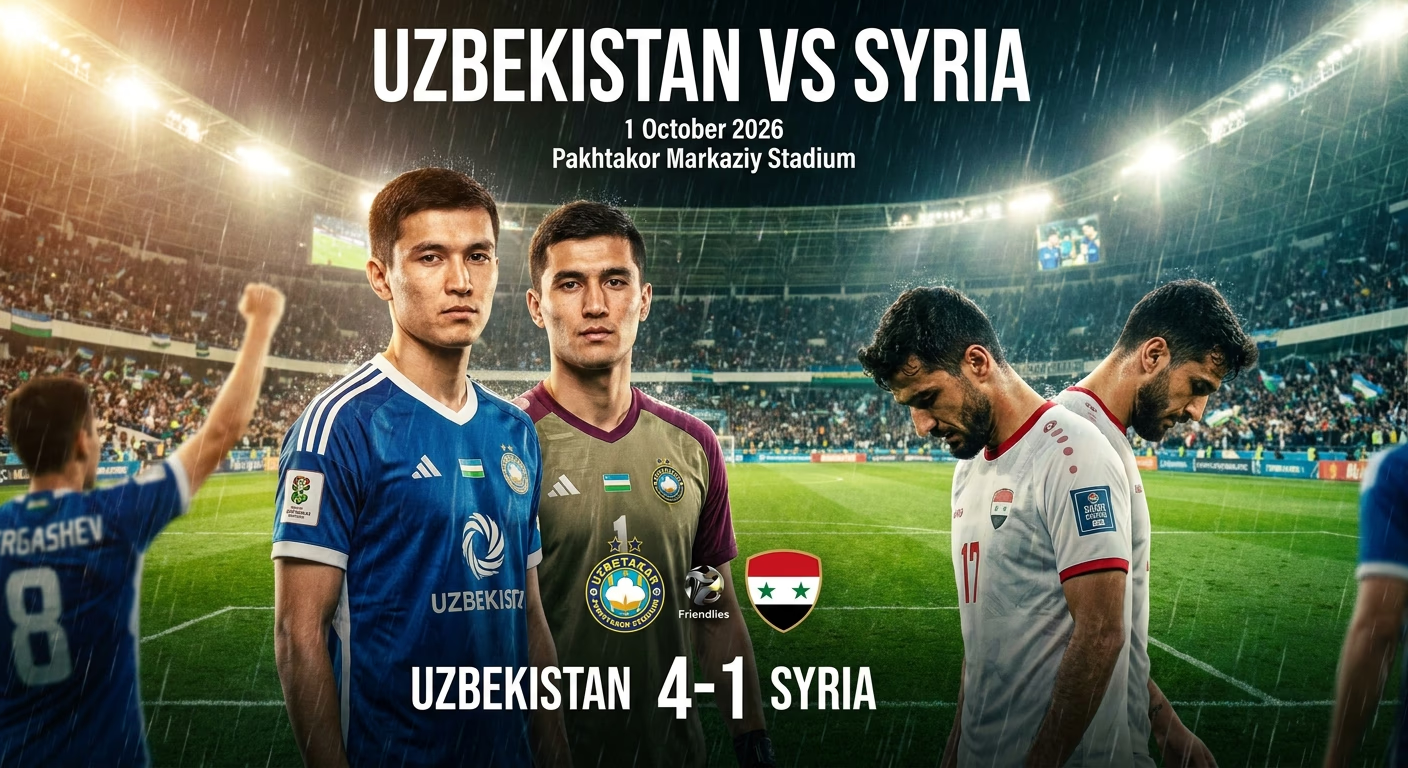
Uzbekistan beat Syria 4-1 on October 1 at Pakhtakor Markaziy Stadium in Tashkent, and the result mattered less as a friendly scoreline than as a clear internal message: F. Cannavaro has a forward reference point in Khuisain Norchaev, and Uzbekistan have another piece of evidence that this group can turn control into goals.
Norchaev was the player who changed the match. He assisted Sherzod Esanov in the 27th minute, scored himself in the 48th minute from an Abbosbek Fayzullaev assist, then added another goal in the first minute of stoppage time after Diyor Khalmatov supplied the final pass. That was direct involvement in three Uzbekistan goals. In a friendly, that is exactly the kind of evidence a coach keeps.
Syria, under Ahmad Al Shaar, did not leave without a response. They changed heavily, tried to reset the game at half-time and again before the hour, and got a late consolation when Abduvokhid Nematov was credited with an own goal in the third minute of stoppage time. But the contest had already been decided by then.
The match story
Syria’s night started badly. Mahmoud Al Aswad was booked in the 12th minute, and Uzbekistan gradually found the cleaner attacking rhythm.
The breakthrough came in the 27th minute. Norchaev, already pulling Syria’s defensive line into uncomfortable choices, assisted Esanov for Uzbekistan’s first goal. No need to dress it up beyond the data: it was a normal goal, but the timing mattered. It gave Cannavaro’s side control of the scoreboard before Syria had settled.
The second arrived in the 45th minute through Akmal Mozgovoy. Again, the event feed gives no extra description, but the effect was obvious: 2-0 at half-time, with Syria forced into decisions.
Ahmad Al Shaar made three substitutions in the 46th minute: Elmar Abraham replaced Mahmoud Al Aswad, Zakaria Hannan came on for Ahmad Dali, and Mohammad Al-Hallaq replaced Alaa Al Dali. It was a strong half-time response on paper. In practice, Uzbekistan killed the restart almost immediately.
In the 48th minute, Fayzullaev assisted Norchaev for 3-0. That was the key moment. Syria’s changes had barely taken shape, and Uzbekistan had already punished the gap between intention and organisation.
More Syria changes followed. Khaled Kerdagli replaced Abdullah Al Shami in the 58th minute. In the 59th minute, Omar Al Soma came on for Can Yahya Moustfa, Abdulrazzak Al Mohammad replaced Noah Shamoun, and Mahmoud Al Mawas came on for Johannes Danho.
Cannavaro waited until the 63rd minute to move. Jasurbek Jaloliddinov replaced Fayzullaev, Khozhiakbar Alizhonov came on for Bekhruz Karimov, and Umarali Rakhmonaliev replaced Odiljon Khamrobekov. That was not panic; it was management. Uzbekistan were already three goals up.
Makhmud Makhamadzhonov was booked in the 78th minute, the same minute Aziz Kholmurodov replaced Azizbek Amanov. Later, in the 85th minute, Nurmukhammad Abduganiev came on for Abdukodir Khusanov and Mukhammad Khakimov replaced Jakhongir Urozov.
Syria made one final change in the 88th minute, with Wessam Dukhan replacing Mohammed Osman. Uzbekistan still had one more blow to land. Norchaev scored again in the first minute of stoppage time, assisted by Khalmatov. Syria’s only goal came in the third minute of stoppage time, an own goal credited to Nematov.
Teams and shapes
The official lineup feed did not publish grid formations. By starting roles, Uzbekistan were listed with Abduvokhid Nematov in goal, four defenders, five midfielders and Khuisain Norchaev as the forward reference under F. Cannavaro.
Uzbekistan started with Nematov behind Bekhruz Karimov, Abdukodir Khusanov, Jakhongir Urozov and Makhmud Makhamadzhonov. The midfield group was Odiljon Khamrobekov, Akmal Mozgovoy, Azizbek Amanov, Sherzod Esanov and Abbosbek Fayzullaev, with Norchaev up front.
Syria, under Ahmad Al Shaar, were listed with Elias Hadaya in goal, four defenders, four midfielders and two forwards. The back line was Ahmad Faqa, Aiham Ousou, Abdullah Al Shami and Johannes Danho. Ahmad Dali, Noah Shamoun, Mohammed Osman and Can Yahya Moustfa were in midfield, with Mahmoud Al Aswad and Alaa Al Dali as the attacking pair.
That structure explains plenty. Uzbekistan had an extra listed midfielder and used the central band better. Norchaev was not isolated because Fayzullaev and Esanov gave him links around the box. Syria, meanwhile, were forced into repair work: first in the 46th minute, then with another wave in the 58th and 59th minutes.
Why Uzbekistan won
Uzbekistan won because their best attacking players were involved in the moments that mattered.
Norchaev was the central figure. His assist in the 27th minute opened the game, his goal in the 48th minute ended Syria’s attempted reset, and his second goal in stoppage time turned a good individual night into a statement performance.
Esanov mattered because he gave Uzbekistan the first goal. Mozgovoy mattered because scoring in the 45th minute changed the half-time conversation completely. Fayzullaev mattered because his assist in the 48th minute gave Uzbekistan the goal that removed most of the tension. Khalmatov mattered because his assist in stoppage time showed Uzbekistan still had runners and timing late on.
For Syria, the problem was not only the score. It was the sequencing: a yellow card to Mahmoud Al Aswad in the 12th minute, a goal conceded in the 27th minute, another in the 45th minute, then a third in the 48th minute. That is a brutal timeline for any coach trying to test players in a friendly.
Numbers
The supplied match data did not include verified possession, shot totals or shots-on-target figures. The clearest measurable story is therefore the event timeline: Uzbekistan scored in the 27th, 45th, 48th and 90+1 minutes, while Syria’s consolation came through a Nematov own goal in the 90+3 minute.
That sequence says enough. Syria reached half-time two goals down, tried to change the match at the interval, and conceded again almost immediately after the restart.
What it means
For Uzbekistan, this was a controlled friendly win with useful evidence for Cannavaro. Norchaev strengthened his case, Esanov and Mozgovoy added end product, and the bench rotation did not stop the scoring.
For Syria, Al Shaar got minutes into a wide group, but the defensive timing needs work. The triple change in the 46th minute and the rush of substitutions in the 58th and 59th minutes showed a coach searching for answers, yet the match had already tilted.
Across the international window, Uzbekistan’s result sits alongside other Asian friendly markers, including Maldives 0-6 Lebanon: Kassas finishes it, Lebanon take full control in Bishkek. Attention now moves to the next fixtures and squad calls. For Uzbekistan, Norchaev has given the staff a simple decision to consider. For Syria, the review starts with the 27th minute, the 45th minute and the 48th minute, because that was where the match went.