
Japan 2-1 Venezuela: Ueda double gives Moriyasu a late friendly win in Hiroshima
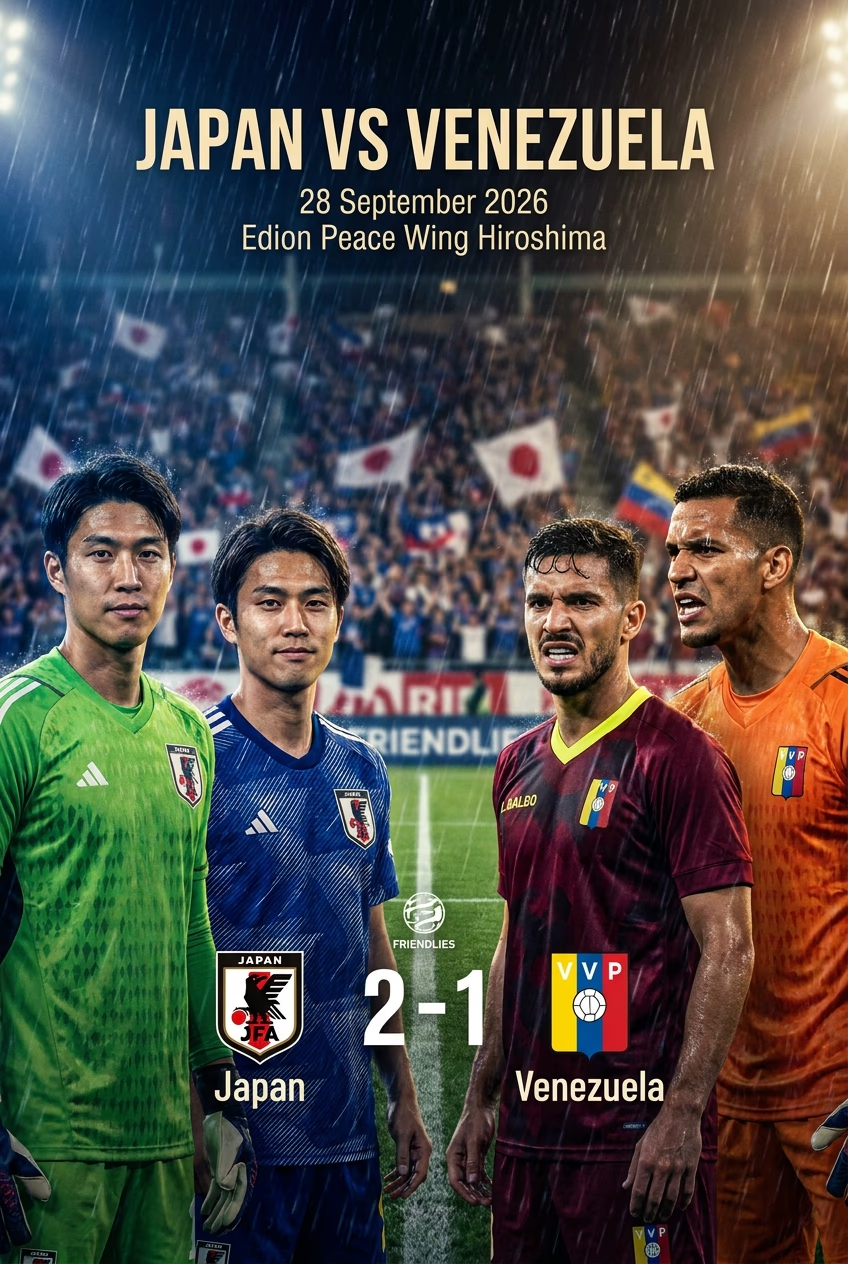
Japan beat Venezuela 2-1 on 28 September 2026 at Edion Peace Wing Hiroshima, and the timeline tells the story clearly. H. Moriyasu changed the game from the bench. A. Ueda finished it.
Venezuela struck first, with K. Kelsy scoring in the 46th minute from a L. Balbo assist. Japan’s answer came almost immediately. Ueda, introduced in the 46th minute, scored in the 49th minute after J. Ito’s assist. Then, deep into stoppage time, Ueda scored again from the penalty spot in the 90+6th minute.
For a friendly, this had bite. There were four yellow cards, three of them after the 90th minute, and a finish that left Venezuela with reason to feel bruised. J. Contreras was booked in the 90+5th minute, Y. Herrera in the 90+7th minute, and A. Tanaka in the 90+8th minute. J. Aramburu had earlier been shown yellow in the 65th minute.
Japan got the result. Venezuela showed enough to trouble them. But the difference was the bench, and specifically the package Moriyasu sent on at half-time: J. Ito, T. Kubo, A. Ueda, A. Tanaka and Z. Suzuki. Ito, Kubo and Ueda gave Japan sharper angles, faster combinations and a real penalty-box target.
Match report
Japan began in a 3-4-2-1 under H. Moriyasu, with L. Kokubo in goal behind T. Watanabe, A. Seko and J. Suzuki. S. Nakano and Y. Soma worked the flanks, K. Kumasaka and D. Kamada started centrally, with R. Sato and S. Saito behind K. Goto.
Venezuela, coached by J. Pekerman, lined up in a 3-4-1-2. J. Contreras started in goal, with Y. Osorio, N. Ferraresi and C. Makoun as the back three. J. Aramburu, M. Libra, Y. Herrera and L. Balbo formed the midfield line, while D. Pereira operated off K. Kelsy and B. Castillo.
Japan’s first plan did not last long. K. Kumasaka went off in the 8th minute, replaced by S. Tanaka. That early change disturbed the rhythm but did not break Japan’s control of possession. Moriyasu’s side finished with 52 percent of the ball and completed 415 of 473 passes.
Still, Venezuela carried danger. Kelsy was the clearest outlet, strong in duels and direct when Venezuela advanced. Balbo gave him the decisive supply in the 46th minute, and Kelsy scored to put Venezuela ahead.
Japan’s response came through the half-time reset. In the 46th minute, Moriyasu made major changes: J. Ito came on for S. Saito, T. Kubo for R. Sato, A. Ueda for K. Goto, A. Tanaka for D. Kamada, and Z. Suzuki for L. Kokubo. Within three minutes, Japan were level. Ueda scored in the 49th minute, assisted by Ito.
That was the decisive adjustment. Ito immediately gave Japan end product from wide areas, finishing with one assist and two key passes. Ueda gave them certainty in the box: two shots on target, two goals. Kubo added control and pressure between the lines, helping Japan keep Venezuela pinned back for longer spells after the break.
Venezuela were not passive. J. Ramírez came on for B. Castillo in the 59th minute, then C. Cásseres replaced D. Pereira in the 60th minute. Pekerman looked for fresh legs and more resistance in midfield. Later, G. Mendoza replaced K. Kelsy in the 71st minute and W. Carmona came on for M. Libra in the 71st minute.
But removing Kelsy also took away Venezuela’s sharpest attacker. He had scored, won seven of nine duels and gave Japan’s back line the most awkward evening. After his exit, Venezuela still had territory, especially from corners, but less threat in the central channel.
Moriyasu then made another triple change in the 72nd minute: R. Doan replaced S. Nakano, H. Ito replaced A. Seko, and K. Nakamura replaced Y. Soma. K. Tanimura later came on for S. Tanaka in the 81st minute.
The match tightened. Venezuela had seven corners to Japan’s one and finished with more shots on goal, five to four. But Japan’s better chances came closer to goal: 10 of their 12 shots were inside the box. That matters. It points to territorial patience rather than hopeful shooting.
The late chaos began with J. Contreras being booked in the 90+5th minute. One minute later, Ueda scored the penalty in the 90+6th minute. Y. Herrera was booked in the 90+7th minute, then A. Tanaka in the 90+8th minute.
Deal done for Japan. Not clean, not calm, but useful.
Why Japan won
Japan’s win came from two things: bench impact and better shot location.
Moriyasu’s starting 3-4-2-1 had control but not enough punch. The half-time changes altered the front line. Ito gave direct service. Kubo carried the ball into pressure. Ueda gave Japan a finisher who needed little volume to decide the game.
Ueda was the difference. He entered in the 46th minute, scored in the 49th minute, then converted the penalty in the 90+6th minute. Two shots on target, two goals. In friendly football, coaches talk about processes. Strikers talk in outcomes. Ueda delivered the outcome.
Ito also changed the speed of Japan’s attacks. His assist in the 49th minute mattered because it gave Japan an instant response after falling behind. Without that quick equaliser, Venezuela could have slowed the game, protected central areas and played through Balbo and Herrera with more comfort.
For Venezuela, Kelsy and Balbo were the key pair. Balbo’s assist in the 46th minute was his main contribution, but his wider numbers were strong too: two key passes, six duels won and one assist. Kelsy was even better, scoring once, producing two shots and winning seven duels before going off in the 71st minute.
The problem for Venezuela was discipline and control late on. Aramburu’s yellow card in the 65th minute was the first sign of stress. The three stoppage-time bookings told the rest.
Key statistics
| Statistic | Japan | Venezuela |
|---|---|---|
| Final score | 2 | 1 |
| Shots on goal | 4 | 5 |
| Total shots | 12 | 9 |
| Shots inside box | 10 | 7 |
| Possession | 52% | 48% |
| Passes | 473 | 439 |
| Pass accuracy | 88% | 87% |
| Corner kicks | 1 | 7 |
| Fouls | 14 | 15 |
| Yellow cards | 1 | 3 |
| Goalkeeper saves | 3 | 2 |
Goals and cards
- 46th minute: K. Kelsy scored for Venezuela, assisted by L. Balbo.
- 49th minute: A. Ueda scored for Japan, assisted by J. Ito.
- 90+6th minute: A. Ueda scored a penalty for Japan.
Yellow cards:
- 65th minute: J. Aramburu.
- 90+5th minute: J. Contreras.
- 90+7th minute: Y. Herrera.
- 90+8th minute: A. Tanaka.
Lineups
Japan, coached by H. Moriyasu, started in a 3-4-2-1:
L. Kokubo; T. Watanabe, A. Seko, J. Suzuki; S. Nakano, K. Kumasaka, D. Kamada, Y. Soma; R. Sato, S. Saito; K. Goto.
Venezuela, coached by J. Pekerman, started in a 3-4-1-2:
J. Contreras; Y. Osorio, N. Ferraresi, C. Makoun; J. Aramburu, M. Libra, Y. Herrera, L. Balbo; D. Pereira; K. Kelsy, B. Castillo.
What it means
For Japan, this was not just a friendly win. It was another reminder that Moriyasu’s depth is a weapon. The starting XI gave him structure, but the substitutes gave him the match.
For Venezuela, the result stings because the plan worked for long stretches. Kelsy and Balbo gave them a lead, the back three competed, and they forced five shots on goal. But the final minutes turned against them.
Japan move on with Ueda’s case strengthened and Ito’s role reaffirmed. Venezuela leave Hiroshima knowing the performance was close, but the result was gone in the 90+6th minute.
Elsewhere in the international window, Uruguay were ruthless in Seoul, as Darwin Núñez led a commanding win over South Korea: South Korea 1-4 Uruguay: Núñez double gives Bielsa a ruthless win in Seoul.